

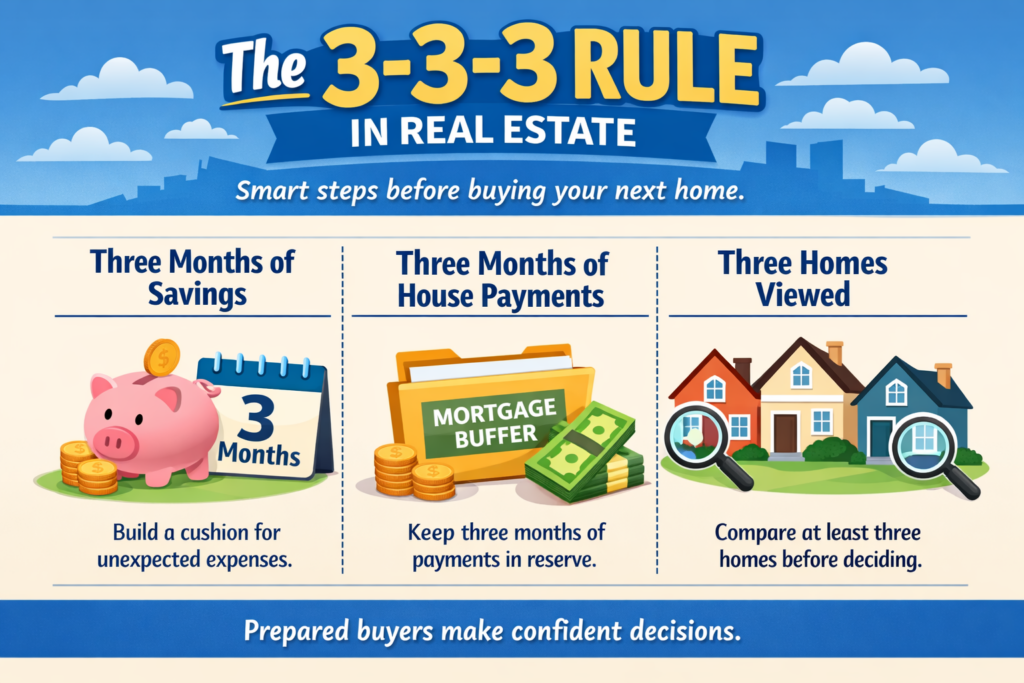
Buying a home without a plan is how people end up house-poor, overextended, and stuck. The 3-3-3 rule provides buyers a simple, proven framework to avoid that outcome, emphasizing the importance of comparing at least three options in their real estate decisions.
Key Takeaways
– Save 3 months of payment before you start shopping to align with the 3-3-3 rule.
– Confirm you can cover three months of mortgage payments from savings alone, aligning with the 3-3-3 rule for financial stability and ensuring you have 3 months of emergency savings.
– Tour at least three similar homes before making an offer to help buyers make informed real estate decisions based on the 3-3-3 rule.
– The 3-3-3 rule protects buyers from financial shock and comparison blindness by ensuring they have adequate reserves for three months of housing costs under 30%.
– It applies whether you’re buying in Kyle, Buda, or anywhere in Hays County, emphasizing the importance of the competitive real estate market.
What Is the 3-3-3 Rule for Homebuyers?
The 3-3-3 rule in real estate is a practical pre-purchase checklist built around three financial and decision-making benchmarks that matter for buyers and investors, addressing frequently asked questions. It’s not a formula invented by lenders—it’s a guideline used by buyers who don’t want to start homeownership already stretched thin.
Each “3” in the 3-3-3 rule addresses a separate risk: cash reserve, mortgage stability, and months of living expenses saved, which are critical components of the 3-3-3 rule. market perspective.
3 Months of Savings: Your Emergency Floor
Why Liquid Savings Matter at Closing
Buying a home depletes cash fast, especially if you don’t have three months of mortgage reserves set aside. Down payment, closing costs, moving expenses, and the inevitable first-month repairs can drain $10,000–$30,000 or more depending on the purchase price.
Arriving at closing with nothing left is a real risk—and it happens more than buyers expect.
What “3 Months of Savings” Actually Means
This isn’t 3 months of mortgage payments. It’s three months of your full monthly living expenses—groceries, utilities, car payment, insurance, subscriptions, and everything else, which is crucial for financial readiness and aligns with the 3-3-3 rule matters.
If your household spends $5,000/month, you need $15,000 in liquid savings *after* closing costs and down payment, which is roughly three months of mortgage payments saved. That’s your floor, not your goal; aim for a better financial position with increased gross monthly income, which will help you buy that home.
Why This Protects You
A job disruption, medical bill, or major home repair in the first 90 days won’t derail you if this cushion of three months of mortgage reserves is in place, safeguarding your significant financial investments. Without it, you’re one unexpected expense away from missing a monthly mortgage payment.
3 Months of Mortgage Payments in Reserve
This Is Separate from Your Emergency Fund
Your general savings cover life expenses, but understanding housing costs is essential for future stability, especially when considering three months of living expenses and months of mortgage reserves. This reserve covers your housing obligation specifically, ensuring you have sufficient living expenses saved. Lenders don’t require it, but financially stable buyers maintain months of emergency savings to safeguard against unforeseen circumstances.
How to Calculate It
Take your projected PITI (principal, interest, taxes, insurance) and multiply by 3. In Hays County, where median home prices in 2024 ranged from $310,000–$380,000, that often means reserving $5,000–$7,500 in mortgage-specific savings to cover three months of mortgage payments.
When This Matters Most
Self-employed buyers, commission-based earners, and anyone with variable income should treat this as non-negotiable. Income gaps happen, impacting gross income levels across different demographics, and understanding these gaps is essential when applying the 3-3-3 rule. This buffer keeps you current on your mortgage without touching daily living funds, ensuring you have months of emergency savings available.
Tour 3 Properties Before Making an Offer
The Comparison Problem in Real Estate
Most buyers see a home they like and want to move immediately. That’s emotion, not strategy, and it can lead to ignoring the 3-3-3 rule is a powerful component of financial decision-making. Without comparison, you can’t assess whether a price is fair, a floorplan is functional, or a neighborhood is the right fit for your monthly payment budget, impacting your financial future.
What 3 Properties Actually Teaches You
The first home sets your baseline for future investments and helps you compare at least three properties before buying a house. The second reveals what you assumed was standard but isn’t in terms of property evaluations and property taxes. The third shows you what trade-offs you’re actually willing to make.
By the third tour, you’re making decisions based on evidence, not excitement, as outlined in the guide for buyers and sellers to ensure a smart financial future using the 3-3-3 rule.
Applying This in Hays County
In a market with active inventory across Kyle, Buda, Wimberley, and San Marcos, touring 3 comparable homes using the 3-3-3 rule is a simple strategy for evaluating market options. is realistic even in lower-inventory cycles. Focus on similar square footage, price range, and school district to make comparisons meaningful in the real estate market, especially when working with real estate professionals who understand the local market.
FAQ
How much should I have in savings before buying a home?
Beyond your down payment and closing costs, aim to have at least three months of general living expenses in liquid savings as part of the 3-3-3 rule. This protects against unexpected repairs, income disruption, or transition costs that catch first-time buyers off guard, ensuring they have three months of emergency savings for their financial future.
Is the 3-3-3 rule an official lending requirement?
No. Lenders will not ask you to prove these reserves in most conventional loan scenarios. This is a personal finance discipline, not a mortgage qualification standard—but buyers who follow this guideline tend to avoid early financial stress.
How many houses should I look at before buying?
A minimum of three comparable properties is a practical threshold. It gives you enough reference to evaluate price, condition, and value accurately, which is essential for making wise real estate decisions using the 3-3-3 rule. In active markets like Hays County, touring more is always better, but you should compare at least three similar homes before committing to ensure you’re ready for the housing costs outlined in the 3-3-3 rule.
What counts as a “comparable” property when touring?
Similar square footage, price range, age of construction, and location. Comparing a new build in Plum Creek to a 1990s resale in Buda won’t give you useful contrast—look at properties competing for the same buyer pool as the home you’re considering to make informed real estate purchases.
Can I use retirement savings to meet the 3-month reserve requirement?
Technically yes, but it’s not recommended when considering total housing costs. Early withdrawal penalties and tax consequences reduce the actual value of those funds, impacting your ability to save for a down payment on buying land or a house, which is crucial for financial stability. The reserve should be in a liquid account—checking, savings, or money market—where it’s accessible without cost or delay.
Conclusion
The 3-3-3 rule isn’t complicated, but most buyers skip at least one of the three steps, which can help buyers avoid costly mistakes in the buying and selling process, especially when something goes wrong. Following all three—before you sign anything—puts you in a position of strength, not just approval. In Hays County’s local market, that preparation is what separates buyers and investors who close with confidence from those who close with regret.
Jesse & Chrissy Sampson | Vine Realty | Serving Hays County, TX